
Prompt Maker
ExploreTopicsPrompt libraryPrompt Maker Canvas
⌘ K
ExploreTopicsPrompt libraryPrompt Maker Canvas

Explore Prompt Maker

  • AI image prompts
  • AI video prompts
  • Creative workflows
  • Image tools
  • AI design workspace

About & services

  • Pricing
  • Terms of Service
  • Privacy Policy
  • Refund Policy

© 2026 Prompt Maker

ZHEN
All prompts/Image/Hero figure, turnarounds, six expressions and prop details

Character Identity Board Views and Expressions Prompt

Image

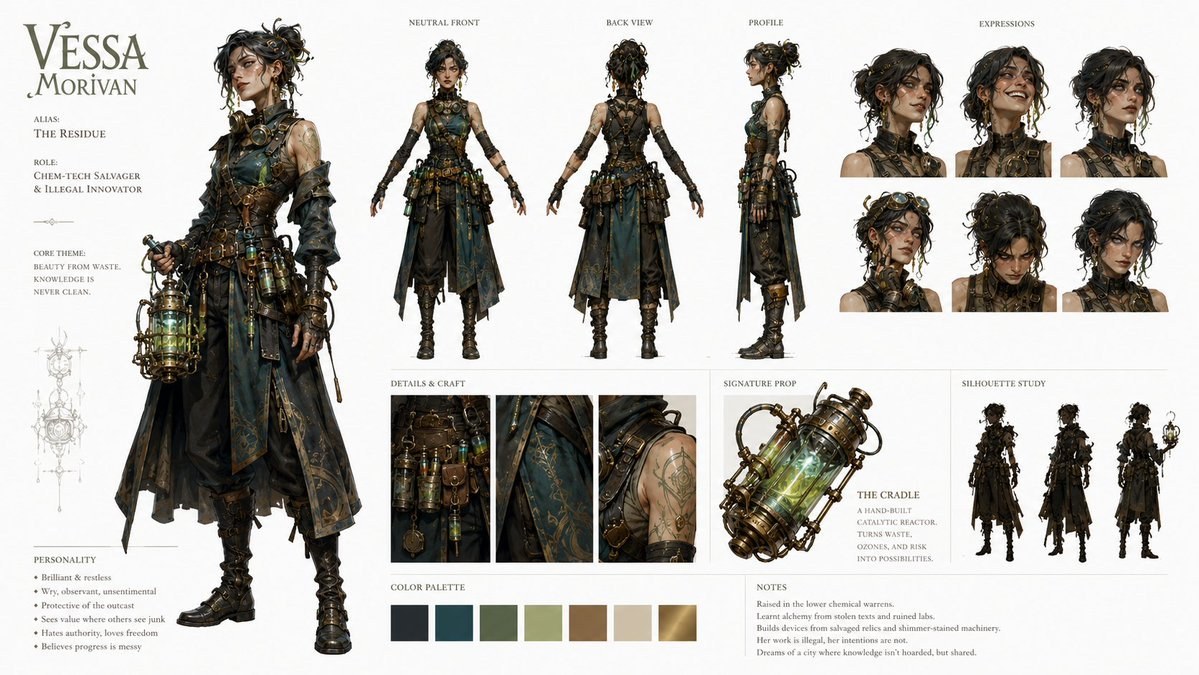
The complete template starts with concept, age/body type, medium and style, then organizes a 16:9 board with hero full-body, front/back/profile, pose, four to six expressions, outfit/anatomy detail, prop, silhouettes and palette. The saved Vessa Morivan example features weathered dark clothing and a green-glowing device without its filled inputs, illustrating layout direction alone. Originality rules are review requirements rather than proof of copyright safety or difference from every existing character. No character was generated or device made.

Image generation

Tool tags help you choose where to try a prompt. They do not verify which model or version created the example.

Prompt

01 / 01
Create a fully original, copyright-safe character and present them as an artistic CHARACTER IDENTITY BOARD.

[CHARACTER SEED]:
Enter the core idea here.

[AGE / BODY TYPE]:
Enter age impression, body type, posture, physical presence or creature anatomy here.

[VISUAL MEDIUM]:
Enter the exact rendering medium here.

[STYLE]:
Enter the aesthetic direction here.

[OTHER DETAILS - OPTIONAL]:
Enter any extra details, constraints, mood, outfit hints, props, colors, themes, personality hints or presentation preferences here.

Invent everything else:
character name, alias or title, role, personality traits, emotional tone, visual theme, outfit design or body design, color palette, signature prop or signature biological feature, recognizable silhouette, pose language, small identity notes.

Originality rules:
The character must not resemble any existing anime, manga, game, movie, comic, celebrity, athlete, mascot, franchise character or known copyrighted creature.
Do not copy recognizable IP elements, costumes, hairstyles, uniforms, weapons, logos, symbols, color combinations, silhouettes, powers or signature visual traits.
Avoid fan-art aesthetics.
Create a fresh visual identity from scratch.

Character authenticity rules:
Create the character with a strong sense of individuality and non-generic design.
Avoid overly polished, overly idealized or repetitive visual features that make the character feel like a default AI-generated face, stock design, cloned archetype or generic creature.

If the character is human or humanoid:
Use distinctive facial structure, subtle asymmetry, natural variation, small imperfections and believable proportions.
The character should feel specific, grounded and recognizably individual.
If the character is attractive, keep the appeal natural, tasteful and appropriate to the chosen visual medium.

If the character is stylized:
Preserve uniqueness through original shape language, expressive proportions, distinctive features, posture and clear personality cues.
Avoid default genre clichés and repeated beauty standards.

If the character is non-human:
Preserve uniqueness through original anatomy, believable biological structure, distinctive proportions, functional features, surface texture and clear personality cues.
Do not make it feel like a generic mascot, pet monster or stock fantasy creature.

Medium and style control:
[VISUAL MEDIUM] controls the rendering language.
[STYLE] controls the aesthetic direction.
The character identity board format is only the presentation format.
The presentation must adapt to [VISUAL MEDIUM] and [STYLE], not override them.
Use visual traits that belong naturally to the selected medium.

Create an artistic 16:9 CHARACTER IDENTITY BOARD.

The board should feel like a curated visual identity presentation, not a generic turnaround sheet.

Board content:
large full-body main character view, neutral full-body view, back view, profile view, secondary attitude pose, 4 to 6 face or expression studies, outfit detail close-ups or anatomy detail close-ups, key prop close-up or signature feature close-up, small silhouette or shape study, color palette strip, short readable identity notes.

Layout:
asymmetrical, elegant, visually memorable, large empty space, clean separation between all views, no overlapping bodies, no cropped faces, no hidden limbs, no clutter.

Text on the board may include:
character name, alias, role, personality traits, core theme, signature prop or feature, color notes.

Background:
pure white or soft off-white, minimal clean graphic design, no environment, no logo, no watermark.

Prioritize:
accurate visual medium, strong unique identity, readable outfit design or anatomy design, clear personality, original character design, natural or stylized individuality as appropriate, believable uniqueness, non-repetitive character design, artistic identity-board presentation.